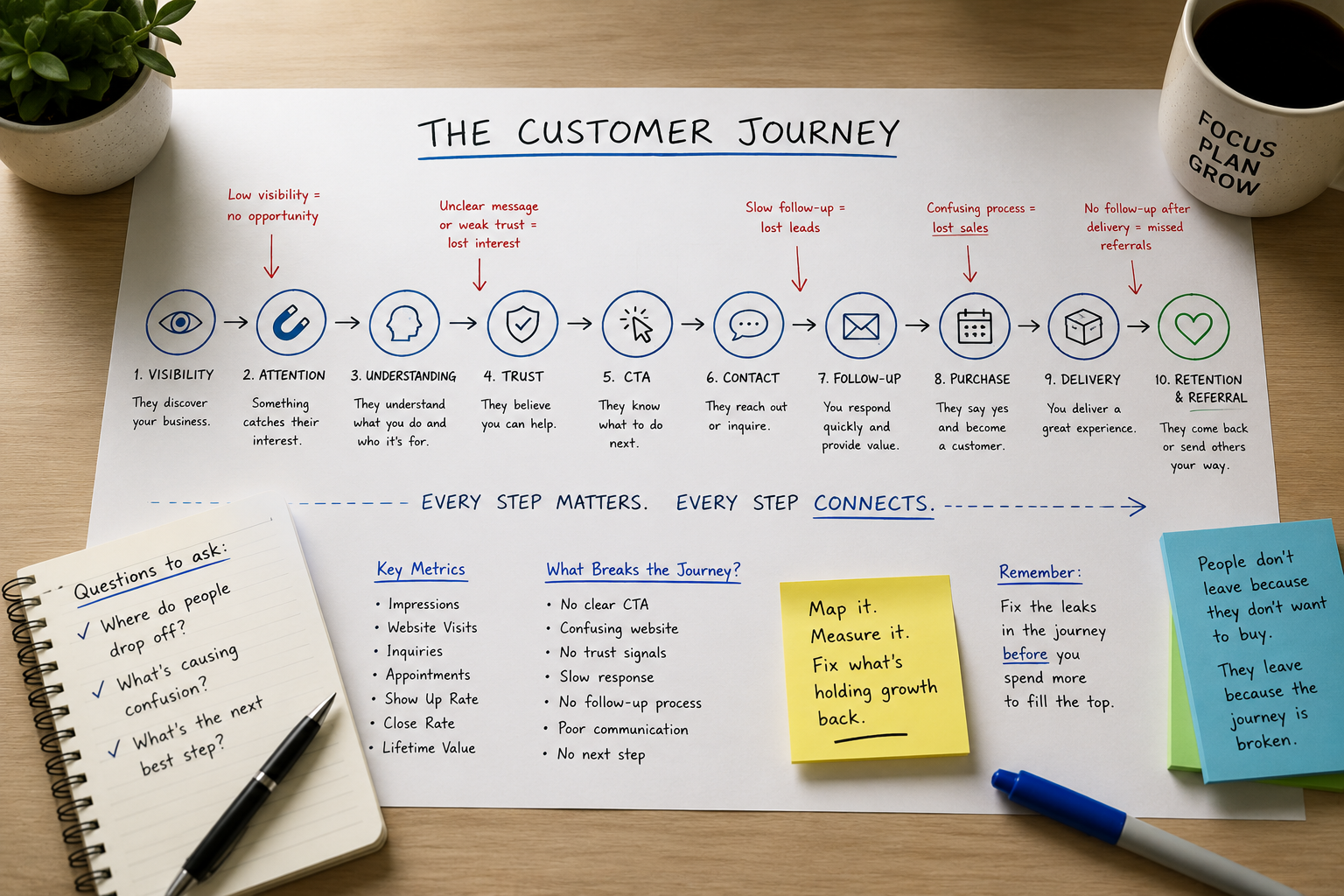
The Customer Journey Most Businesses Never Think About
A lot of business owners think about marketing and sales as two separate things.
Marketing gets attention.
Sales closes the customer.
But there is an entire path between those two points—and that is usually where the real problem is hiding.
Someone has to discover the business.
They have to understand what it does.
They need a reason to trust it.
They need to know what to do next.
Someone has to respond.
The prospect has to show up, make a decision, and then actually receive the experience they were promised.
That entire process is the customer journey.
And if any part of it is unclear, slow, inconsistent, or missing, people leave.
The short answer
A customer journey is the full experience someone has with your business from the moment they first become aware of it through the sale, delivery, follow-up, and potential repeat business or referral.
A simple version looks like this:
Visibility
Attention
Understanding
Trust
Call to action
Contact
Follow-up
Purchase
Delivery
Retention or referral
Most businesses focus heavily on one or two of those stages.
They may post constantly but have no clear call to action.
They may generate inquiries but respond too slowly.
They may close customers but never ask for reviews or referrals.
The goal is not to make every part complicated.
It is to make sure every stage helps the right person move naturally to the next one.
The journey usually breaks before the customer ever contacts you
When I first look at a business, the biggest issue is often not the sales conversation.
It is visibility.
The business may have little to no online presence.
It may not appear consistently on social media.
Its Google presence may be weak.
The website may exist, but very few people know it is there.
The owner may be excellent at what they do, but the market has almost no opportunity to discover them.
That creates a customer journey with no real beginning.
You cannot guide someone through a buying decision if they never become aware that the business exists.
Visibility is the first stage—not the entire strategy
Visibility matters.
The business needs to appear in the places where potential customers are already spending time.
That may include:
Google search
Google Business Profile
Social media
Local directories
Referrals
Partnerships
Email
Paid advertising
Community involvement
Industry platforms
The company website
But visibility alone does not guarantee results.
A business can receive thousands of views and still produce very few serious inquiries.
That is because attention only creates an opportunity.
It does not automatically explain the offer, establish trust, or tell someone what to do next.
This is also why more leads will not always fix your business. If the next stages are weak, additional traffic may only send more people into the same broken process.
Attention needs somewhere to go
Once someone notices the business, what happens next?
Do they visit a website?
Check the social profile?
Read reviews?
Send a direct message?
Call?
Ask a friend?
A common problem is that the business creates attention but does not direct it anywhere.
The social content may be entertaining, but there is no explanation of the service.
The advertisement may look good, but the landing page is confusing.
The website may have information, but the main action is buried.
The profile may be active, but there is no useful link or pinned explanation.
The person is interested—but they are not guided.
That is where a strong call to action becomes important.
A call to action should remove uncertainty
A call to action is not just a button.
It is a clear instruction that tells the person what to do next and what they should expect.
Examples include:
Request a quote
Book a consultation
Schedule an appointment
View available services
Call for same-day availability
Complete the Business Breakdown
Download the guide
Send a message with your project details
Weak calls to action often sound vague:
Learn more
Get started
Discover
Explore
Contact us
Those phrases are not always wrong, but they often leave important questions unanswered.
Get started with what?
What happens after I contact you?
Am I booking, buying, asking a question, or committing to something?
A better call to action makes the next step feel specific and safe.
The website has to support the journey
Once someone clicks through, the website needs to continue the same conversation.
The visitor should be able to understand:
What the business does
Who it serves
What problem it solves
Why it is credible
What the offer includes
What they should do next
If the advertisement says one thing, the social profile says another, and the website looks outdated or unclear, trust drops.
The customer starts wondering whether they are in the right place.
Before adding more traffic, use the 10-second website test to check whether someone can quickly understand the business, trust the page, and find the next step.
The website does not have to explain everything immediately.
It does need to reduce confusion.
Trust is built through small signals
A customer rarely makes a decision based on one single trust signal.
They combine several small pieces of information:
The website looks current
The offer is clearly explained
Reviews are visible
The business responds professionally
Photos appear real
The process makes sense
Pricing has enough context
The founder or team feels credible
The next step feels organized
Previous customers appear satisfied
Each signal reduces uncertainty.
A missing trust signal does not always kill the sale by itself.
But several missing signals together can make the business feel risky.
That is why the customer journey should not be reduced to a single marketing channel.
The website, content, reviews, offer, follow-up, and customer experience all work together.
A real example: attention without fast follow-up
I worked with a client in the past who was generating more than 100,000 impressions per month.
The visibility was there.
People were seeing the business.
But the follow-up process sometimes took days—or even weeks—before the business actually contacted potential customers.
The business was still closing roughly 40 to 60 per month, but the delay made one thing obvious:
The attention was not the main problem.
The real weakness was what happened after someone showed interest.
By the time the business responded, the prospect may have:
Forgotten why they reached out
Contacted a competitor
Solved the problem another way
Lost urgency
Assumed the business was unavailable
Decided the company was disorganized
More visibility could not fix that.
The business already had attention.
It needed a faster and more dependable path from interest to conversation.
Response time shapes the customer’s first real experience
The first direct interaction often happens after someone submits a form, calls, sends a message, or asks for pricing.
That moment matters.
The customer is no longer passively browsing.
They have raised their hand.
A slow or unclear response can undo the trust built by the marketing.
Questions to review include:
How quickly does someone respond?
Who owns the inquiry?
Does the prospect receive confirmation?
Is the answer helpful?
Is there a clear next step?
Is the lead recorded somewhere?
Is a follow-up task created?
What happens if the person does not reply?
The process should not depend entirely on someone remembering to check an inbox later.
Follow-up is part of marketing
Many business owners think marketing ends when the lead submits a form.
It does not.
Follow-up affects whether the original marketing investment creates revenue.
A business may spend money on:
Advertisements
Content
SEO
Website design
Social media
Lead platforms
Sponsorships
Networking
But if nobody follows up consistently, the real return on that investment will always look weaker.
Useful follow-up may include:
Confirming the inquiry was received
Answering the person’s question
Offering a specific booking time
Sending a reminder
Following up after a quote
Sharing relevant proof
Clarifying the next step
Closing the loop when the prospect is not interested
Follow-up should not feel like harassment.
It should feel organized.
The booking process should be easy to understand
After the response, the customer may need to schedule a call, appointment, estimate, or consultation.
That step can create another drop-off point.
Common problems include:
Too many form fields
No available appointments
Confusing meeting types
No confirmation
No reminder
Long delays before the appointment
No explanation of what will happen
Requiring unnecessary phone calls
Making the customer repeat information
The booking experience gives the customer an early preview of what it may feel like to work with the business.
If booking is difficult, they may assume delivery will be difficult too.
Show-up rate is part of the journey
Booking an appointment does not guarantee attendance.
A weak show-up rate may indicate:
The lead was not qualified
The appointment felt low-value
The customer forgot
The meeting was scheduled too far away
Reminders were missing
The next step was not explained
The person never felt committed
Rescheduling was difficult
That is not always a lead-generation problem.
It may be a communication problem.
The customer journey includes everything the person experiences before the meeting actually begins.
The sales conversation should continue the same message
When the prospect finally reaches the call, appointment, or consultation, the message should feel consistent.
The business should not suddenly become confusing.
A good conversation should help the prospect understand:
Their current problem
What may be causing it
The recommended solution
Why that recommendation fits
What the process looks like
What the investment includes
What happens next
The goal is not to pressure every person into buying.
The goal is to make the decision clear.
When the recommendation does not match the marketing, offer, or customer’s actual need, trust falls apart.
The customer journey does not end at the sale
A lot of businesses stop thinking about the journey once payment is collected.
But delivery affects:
Retention
Reviews
Referrals
Repeat purchases
Testimonials
Reputation
Future marketing
Customer lifetime value
After the sale, the customer still needs:
Clear onboarding
Expectations
Communication
Progress updates
Reliable delivery
An easy way to ask questions
A clear completion point
A thoughtful follow-up
A strong experience after the sale creates the proof that helps future customers trust the business.
Every completed job should create the next opportunity
The end of one customer journey can become the beginning of another.
After a successful project, service, or engagement, the business may be able to generate:
A Google review
A testimonial
A referral
A case study
A before-and-after example
A repeat purchase
A maintenance plan
A social media story
A useful customer question for future content
This should not happen by accident.
The business should have a simple process for asking.
Without that process, satisfied customers disappear quietly even when they would have been happy to help.
How to map your current customer journey
Not sure where customers are dropping off?
The free Business Breakdown helps you review your visibility, website, offer, customer journey, follow-up, and business systems so you can see what may need attention first.
You do not need complicated software to begin.
Write down the stages a customer moves through.
Start with:
How do people discover us?
What do they see first?
Where do they go next?
What helps them trust us?
What action do we ask them to take?
How quickly do we respond?
How do they book?
What happens before the appointment?
How do we present the offer?
What happens after they buy?
How do we ask for a review or referral?
Then add the numbers you currently know.
For example:
Monthly impressions
Website visits
Form submissions
Phone calls
Direct messages
Qualified inquiries
Appointments booked
Appointments attended
Sales closed
Repeat customers
Reviews received
Referrals generated
You are looking for the largest unexplained drop.
That gives you a place to investigate.
What the numbers may be telling you
Different patterns suggest different problems.
Little or no attention
Likely areas to investigate:
Visibility
Search presence
Content consistency
Local listings
Referrals
Advertising
Positioning
Attention but few website visits or inquiries
Likely areas to investigate:
Call to action
Message clarity
Audience relevance
Link placement
Offer interest
Profile trust
Website visits but few contacts
Likely areas to investigate:
Website clarity
Trust
Offer
Mobile experience
Contact friction
Page speed
Call-to-action placement
Inquiries but few bookings
Likely areas to investigate:
Response time
Lead ownership
Scheduling
Qualification
First-response quality
Follow-up
Bookings but low attendance
Likely areas to investigate:
Confirmation
Reminders
Appointment delay
Perceived value
Qualification
Rescheduling
Attendance but low close rate
Likely areas to investigate:
Offer clarity
Pricing context
Proof
Sales process
Recommendation quality
Follow-up after the call
Customers but few reviews or referrals
Likely areas to investigate:
Delivery quality
Completion process
Review request
Referral process
Ongoing communication
What I would check first
The first question is:
Are enough of the right people seeing the business?
If the answer is no, start with visibility.
If the business is already receiving attention, the next question is:
Are people being clearly told what to do next?
If the call to action is weak or missing, start there.
Then follow the path:
Did they click?
Did they understand?
Did they trust?
Did they contact?
Did someone respond?
Did they book?
Did they show?
Did they buy?
Did they receive a strong experience?
Did the business ask for the next opportunity?
This is how you move from guessing to diagnosing.
For a broader review of the entire business, read how to find what is actually holding your business back.
The real constraint may be in the customer journey—but it could also be the offer, capacity, pricing, systems, or positioning.
Do not fix every stage at once
Mapping the full customer journey may uncover several problems.
Do not try to rebuild everything in one week.
Start with the largest drop or clearest point of confusion.
For example:
If nobody sees the business, improve visibility.
If people see it but take no action, clarify the CTA.
If leads arrive but sit unanswered, fix response time.
If appointments do not show, improve confirmation and reminders.
If qualified prospects do not buy, review the offer and sales process.
If customers are happy but never refer, build a referral request.
Fix one meaningful constraint.
Measure what changes.
Then move to the next stage.
That is far more useful than making random improvements everywhere.
Final takeaway
The customer journey is not a marketing funnel on a slide.
It is the real experience people have with your business.
It begins before they know your name.
It continues through the website, content, proof, contact process, follow-up, booking, sale, and delivery.
And it does not end until the customer either leaves, returns, or tells someone else.
Most businesses do not need every stage rebuilt.
They need to identify the stage where people are leaving and make the next step clearer.
That is where I would start.
Fix the right problem first.
Your customer journey may not be completely broken.
One or two stages may simply be making it harder for people to take the next step.
Complete the free Business Breakdown to identify what I would investigate first