How to Find What Is Actually Holding Your Business Back
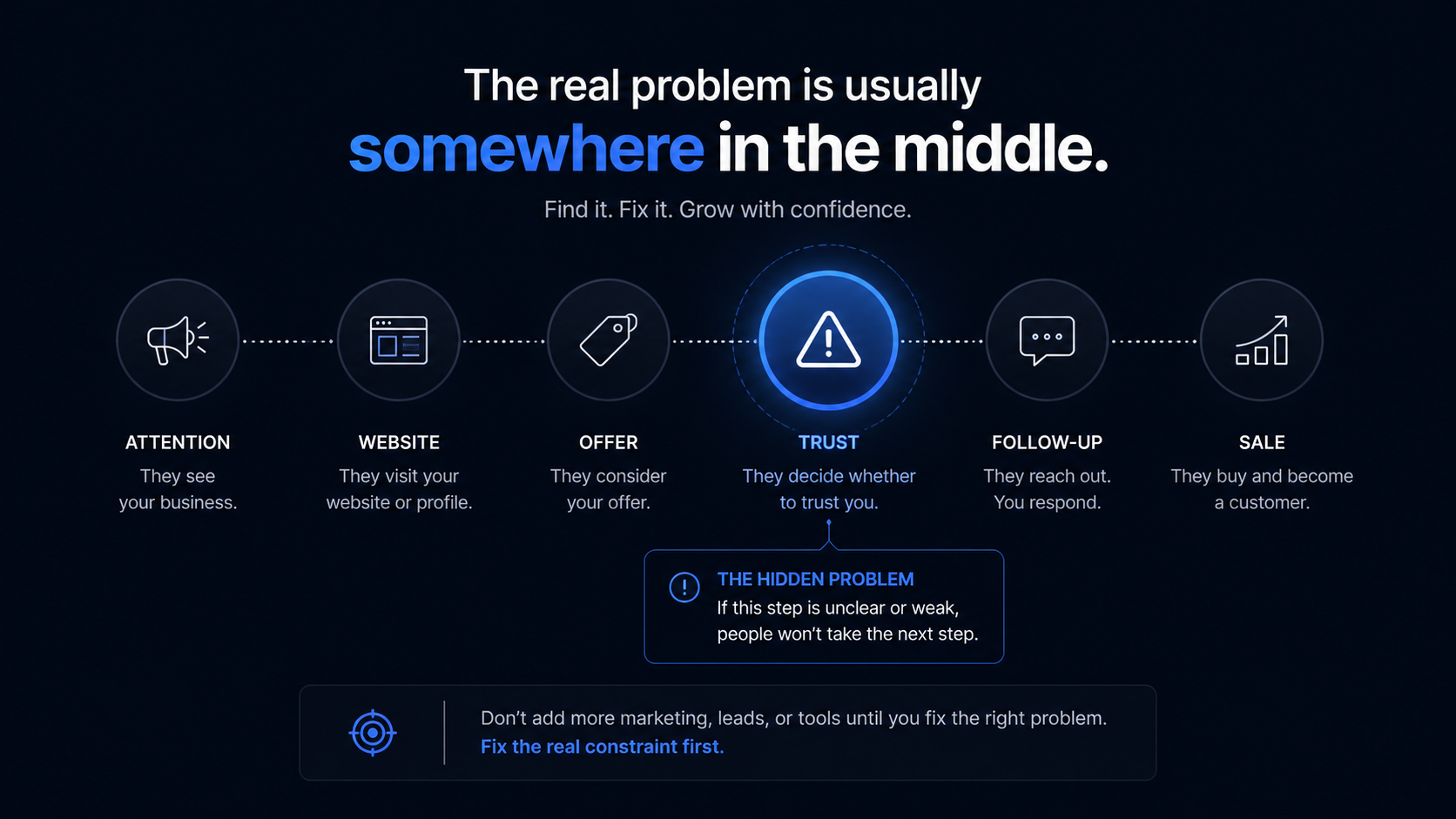
To find what is actually holding your business back, do not begin by asking what marketing tactic you should try next.
Start by tracing how someone discovers your business, decides whether to trust it, reaches out, gets followed up with, and eventually becomes a customer. The first meaningful stage where qualified people consistently slow down, leave, or fail to take the next step is usually the best place to investigate first.
The problem may be visibility. It may be the offer, website, proof, follow-up, sales process, or internal systems.
The goal is not to fix everything at once. The goal is to find the right problem first.
Why business problems are easy to misdiagnose
Most business problems appear as symptoms.
You may notice that revenue is inconsistent, leads are slowing down, people are asking for prices and disappearing, or the business feels busy without moving forward.
Those symptoms are real, but they do not always tell you what caused the problem.
For example, a business may assume it needs more leads because bookings are down. But the business could already be receiving enough inquiries. The larger issue may be that replies take too long, quotes are never followed up with, or the booking process is confusing.
Another business may assume its website needs a complete redesign. But the real problem may be that the offer itself is difficult to understand. A better-looking website will not automatically make an unclear service easier to buy.
This is why random marketing can become expensive.
The business keeps treating the symptom without finding the point where the customer journey is actually breaking down.
What business owners usually try first
When something feels wrong, it is natural to reach for the most visible solution.
That usually means:
Posting more content
Running more ads
Rebuilding the website
Changing prices
Adding another service
Buying new software
Hiring another person
Any of those decisions could be correct.
But none of them should be the automatic answer.
Before recommending a tactic, I would want to understand where people are getting stuck. Otherwise, the business may add more attention, tools, or work on top of a problem that already exists.
More leads will not fix weak follow-up.
A new website will not fix an unclear offer.
More content will not fix a customer path with no obvious next step.
New software will not fix a process nobody owns.
Diagnosis comes before the prescription.
The Fix-First Framework
Here is the practical process I would use to identify what may actually be holding the business back.
1. Define the result you are trying to improve
“Grow the business” is too vague.
Start with a result you can clearly describe.
That could be:
More qualified inquiries
More booked appointments
A better close rate
A higher average sale
More repeat customers
More referrals
More consistent monthly revenue
Less time spent managing avoidable problems
The clearer the desired result is, the easier it becomes to investigate what is stopping it.
If the goal is more booked appointments, you can review the steps between someone discovering the business and booking.
If the goal is more repeat business, you can review the customer experience after the first purchase.
Without a defined result, every area of the business can look equally important.
2. Map the path a customer actually takes
Write down the real customer path from beginning to end.
For many businesses, it looks something like this:
Attention → Profile or website → Offer → Proof → Contact → Follow-up → Sale → Repeat business or referral
Your path may include more steps, but keep the first version simple.
Then ask what happens at each stage.
How do people usually discover you?
Where do they go next?
Can they quickly understand what you do?
Do they see enough proof to trust you?
Is the next step obvious?
What happens after they call, submit a form, or send a message?
Who follows up?
How does the business move them toward a decision?
A lot of business owners know individual pieces of this process, but they have never looked at the complete path from the customer’s point of view.
That is where hidden gaps become easier to see.
3. Find the first meaningful drop-off
The first drop-off matters because problems near the beginning of the customer path affect everything that happens after them.
Suppose a business receives plenty of website visitors, but very few people contact it.
The first issue may be website clarity, the offer, trust, or the call to action.
It would be premature to blame the sales team because most visitors never reached a sales conversation.
Now suppose the website consistently creates inquiries, but those inquiries rarely become appointments.
The website may be doing its job. The larger issue may be response time, lead qualification, follow-up, or the booking process.
Look for the earliest stage where the numbers, customer behavior, or team experience begin to weaken.
That is usually where I would start.
4. Confirm the problem with simple evidence
You do not need an enormous analytics system to begin.
Use the information you already have and answer a few practical questions:
Which channels create inquiries?
How many inquiries become booked calls or appointments?
How quickly does someone receive a response?
What happens after a quote or proposal is sent?
Why do customers commonly hesitate?
Which services are easiest to sell?
Where do missed calls, forms, emails, and messages go?
Which marketing activity has created actual customers?
What do customers frequently ask before buying?
What happens after the service is completed?
Some answers may come from analytics or a CRM. Others may come from reviewing emails, call logs, forms, messages, sales notes, or customer questions.
The point is not to create a perfect dashboard overnight.
The point is to stop making decisions entirely from instinct.
5. Fix one meaningful problem before adding more tactics
Once you identify a likely constraint, give that area focused attention.
If response time is the issue, establish ownership and a response process.
If the offer is unclear, simplify how it is explained before rebuilding the entire website.
If people do not trust the business, improve how reviews, proof, experience, guarantees, or process information are presented.
If the business receives qualified opportunities but does not close them, review the sales conversation, pricing presentation, follow-up, and decision process.
Set a defined review period and watch what changes.
Trying to repair five areas simultaneously makes it difficult to know which change actually helped.
Seven common areas that may be holding a business back
Most problems I review fall into one or more of these areas.
1. Qualified attention
The right people are not consistently discovering the business.
This may be a marketing, search visibility, advertising, referral, local presence, or content-distribution issue.
The important word is qualified. More attention from the wrong audience does not solve the problem.
2. Offer clarity
People can see the business, but they do not quickly understand what is being sold, who it is for, what is included, or why it is valuable.
This often appears when people ask basic questions that the website or sales material should have already answered.
3. Website and customer-path clarity
People are interested, but the next step feels difficult or unclear.
They may struggle to find the right service, understand the process, request a quote, book an appointment, or know what happens after contacting the business.
The website should make buying easier, not create another puzzle.
4. Trust and proof
The offer makes sense, but the customer does not feel confident enough to act.
Reviews, case studies, examples, credentials, process explanations, guarantees, and clear expectations can all reduce uncertainty when they are genuine and relevant.
5. Lead response and follow-up
People raise their hands, but the business responds slowly, follows up inconsistently, or has no clear owner for the lead.
This is one of the easiest problems to overlook because the business technically received the inquiry. The opportunity is then quietly lost after it arrives.
6. Sales and booking process
Leads are being contacted, but too few move forward.
The problem may involve qualification, pricing presentation, unclear packages, weak discovery questions, unanswered objections, or no defined next step.
7. Systems and measurement
The business is active, but nobody can confidently explain what is producing customers or where opportunities are being lost.
When everything lives inside separate inboxes, spreadsheets, platforms, and people’s memories, good decision-making becomes difficult.
A simple example
Imagine a local service business running paid ads because it wants more appointments.
The ads create traffic. People visit the landing page. Some complete the contact form.
But the business only checks new forms a few times each day. Some inquiries wait until the next morning. Others receive one response and no second follow-up.
The owner may look at the appointment total and conclude that the ads are not working.
But the ads may not be the first problem.
The first meaningful drop-off happens after the inquiry is submitted.
Increasing the advertising budget would probably send more people into the same weak follow-up process. The cleaner first step would be to improve lead notifications, ownership, response time, and follow-up—then evaluate the advertising again.
That is what “fix the right problem first” looks like in practice.
How to know whether you found the right problem
You may be looking at the right issue when:
It explains several symptoms at once
It appears consistently rather than as a one-time event
Customers or leads experience it directly
The team can describe when and why it happens
You can measure what changes after addressing it
Improving it makes later stages of the customer path easier
A useful diagnosis creates focus.
It tells the business what deserves attention now—and what can wait.
A quick business constraint checklist
Before spending more money or adding another project, ask:
Are enough of the right people discovering the business?
Can they quickly understand the offer?
Is there enough proof for them to trust it?
Is the next step obvious and easy?
Does every inquiry have an owner?
Are leads receiving timely and consistent follow-up?
Is the sales or booking process clearly defined?
Do we know which activities create customers?
Can the business successfully deliver if demand increases?
Which single improvement would have the greatest effect on the rest of the customer path?
You do not need perfect answers to all ten questions.
You are looking for the first answer that exposes a meaningful weakness.
Do not confuse activity with progress
A business can be extremely busy and still lack clarity.
It can publish content, run ads, change its website, attend meetings, test software, and build new offers without knowing which activity is actually improving performance.
The answer is not always to work harder.
Sometimes the most valuable decision is to stop, examine the full customer path, and identify the one problem that deserves attention before anything else is added.
Jeremy Arana Media uses this diagnosis-first approach to connect marketing, websites, offers, customer experience, follow-up, sales, and business systems.
Because the goal is not another random recommendation.
The goal is to understand what is actually happening and decide what to fix first.
Not sure where to start?
The free Business Breakdown is a short diagnostic that helps you examine areas such as marketing, offer clarity, website experience, lead handling, customer journey, and business systems.
It will not replace a complete business review, but it can help you identify which area may deserve a closer look.
Complete the free Business Breakdown and find your next priority.