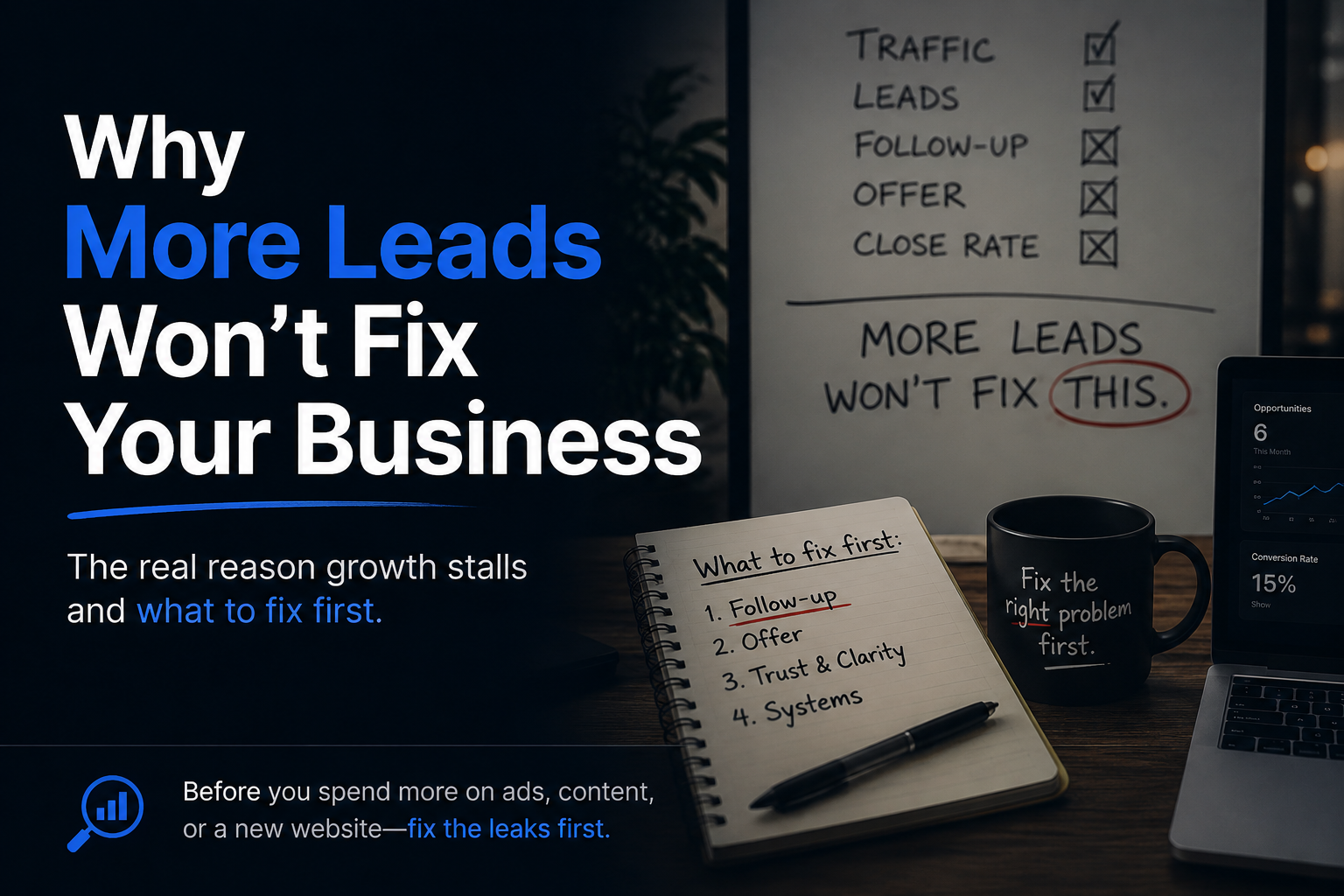
Why More Leads Won't Fix Your Business
A lot of business owners think the answer is more leads.
More ads. More traffic. More content. More people filling out forms. More calls coming in.
Sometimes that is the real issue.
But a lot of the time, the business is already creating interest and losing people somewhere after that.
That is the part I would check first.
More leads will not fix an unclear offer, inconsistent visibility, slow follow-up, a weak booking process, a low show-up rate, or a sales process that is not turning conversations into customers.
It may only give the business more opportunities to lose.
The direct answer
If your business is already receiving inquiries but not producing enough customers, do not assume the problem is lead volume.
First, look at:
Where people are finding you
Whether your marketing is consistent
Whether the offer is strong and easy to understand
How quickly leads receive a response
Whether there is a clear next step
How many inquiries become booked calls
How many booked calls actually show up
How many attended calls become customers
The goal is not to avoid lead generation.
The goal is to make sure the business can handle and convert the attention it already has before paying for more.
Two businesses can have leads and still have completely different problems
I recently looked at two different businesses that both believed lead generation was an important issue.
The first business was already receiving roughly 20 to 40 leads per month.
That is not an enormous number, but it is enough activity to learn from.
The business did not have a real social media strategy in place, so it was leaving visibility and trust-building opportunities on the table. The service was also relatively low-cost, which suggested the offer itself could potentially be packaged or positioned more strongly.
The second business was receiving around 40 inquiries but only generating roughly 6 to 10 client calls.
Even after a call was booked, the show-up rate and close rate were low.
Those are not the same problem.
The first business may need stronger visibility, more consistency, and a better offer.
The second business needs to understand what is happening between inquiry, booking, attendance, and the final decision.
Telling both businesses to simply “get more leads” would ignore the actual issue.
More leads can hide the real problem
Lead generation is attractive because it feels measurable.
You can count form submissions, messages, phone calls, website clicks, and appointments.
That makes it easy to say:
We only need more people coming in.
But the number at the top does not explain what happens below it.
A business could generate 100 inquiries and still have poor results if:
Replies take too long
The first response is vague
Nobody owns the lead
The offer is confusing
The website does not create trust
There is no clear booking step
Prospects do not receive reminders
Quotes are never followed up
Sales calls feel unstructured
Nobody tracks why prospects say no
The reality is, lead generation is only one part of the customer path.
The customer path matters more than the lead count
A lead does not become revenue automatically.
There are several steps between first awareness and a completed sale.
A simple customer path may look like this:
The person discovers the business.
They decide whether the business looks credible.
They visit the website or profile.
They try to understand the offer.
They contact the business.
Someone responds.
They book a call or appointment.
They attend.
They make a decision.
The business follows up when necessary.
Every step creates another place where the opportunity can be lost.
When a business owner tells me they need more leads, my first question is not automatically:
How do we get more traffic?
It is:
Where are people dropping off now?
That is where I would start.
What business owners usually assume
A lot of business owners think getting more leads is mainly about paid advertisements and having a great personality.
Both can help.
Advertising can create visibility. Personality can make a business more relatable and easier to trust.
But in reality, I believe the bigger issue is often visibility, consistency, and follow-up.
People need to repeatedly see and understand the business.
They need to know what the company does, who it helps, why they should trust it, and what to do next.
Then, once they show interest, the business needs a process that does not depend on someone remembering to reply later.
A strong personality cannot rescue a lead that never receives a response.
An effective advertisement cannot fix a confusing offer.
More traffic cannot repair a follow-up process built around “hopefully they get back to us.”
Check visibility before assuming the market is not interested
A business may technically exist online without being meaningfully visible.
Posting once every few weeks, running one short advertisement, or having an outdated website does not create consistent awareness.
Visibility is not just reach.
It is whether the right people repeatedly encounter a clear message from the business.
Ask:
Does the business regularly appear where customers spend time?
Is the message consistent across the website, social pages, ads, and sales conversations?
Does the content explain the service or only show random activity?
Is the business building familiarity before asking for a sale?
Can someone quickly understand why the business is relevant to them?
Sometimes the business does need more attention.
But “more attention” does not always mean buying more leads.
It may mean becoming easier to find, easier to recognize, and easier to understand.
Check consistency before adding another channel
A lot of businesses are doing a little bit of everything.
They post occasionally.
They try paid advertisements for a few days.
They update the website when something feels outdated.
They ask for reviews when they remember.
They follow up when there is time.
That can create activity without creating momentum.
Consistency matters because customers rarely make decisions from one isolated touchpoint.
They may see a post, visit the website later, read a review, compare options, ask a question, and return a week later.
If the business looks inactive, inconsistent, or different everywhere, trust drops.
Before adding another channel, check whether the current ones are being used well.
Check whether the offer is strong enough
A business can receive leads and still struggle because the offer is too weak, too cheap, too confusing, or too difficult to compare.
A lower-cost offer is not automatically bad.
But it can create problems when:
The business needs too many customers to hit its revenue target
The service sounds similar to every competitor
The package does not communicate enough value
There is no clear difference between basic and premium options
The offer attracts people who care only about the lowest price
The company provides more work than the price can realistically support
The question is not only:
Are leads coming in?
It is also:
Are the right people interested in the right offer at the right price?
If the offer is weak, more leads may create more low-value conversations rather than stronger customers.
Check response time and ownership
The easiest lead to lose is often the one that already raised their hand.
Someone calls, sends a message, completes a form, or asks for pricing.
Then they wait.
Maybe the message goes to a shared inbox.
Maybe nobody knows who is responsible.
Maybe the reply arrives two days later.
Maybe the response says, “Let us know how we can help,” even though the person already explained what they need.
This sounds small, but it matters.
A lead should have:
A clear owner
A fast first response
A useful answer
A specific next step
A follow-up task if they do not respond
The process should not depend entirely on memory.
Check the inquiry-to-booking rate
The second client example is a good reason to separate inquiries from calls.
If a business receives around 40 inquiries but only books 6 to 10 calls, the issue may be happening before the sales conversation even starts.
Questions to investigate:
Are leads receiving a clear invitation to book?
Is scheduling easy?
Are there too many steps?
Is the first response building enough trust?
Are appointment times convenient?
Is someone following up after the initial inquiry?
Are unqualified inquiries being counted as serious opportunities?
Does the prospect understand what the call is for?
A business should know how many inquiries become actual conversations.
Without that number, it is easy to blame lead generation for a booking problem.
Check the show-up rate
A booked call is not the same as an attended call.
If show-up rate is low, check:
Whether the prospect understands the value of the meeting
How far in advance the appointment is scheduled
Whether confirmation emails or messages are sent
Whether reminders are used
Whether rescheduling is easy
Whether the business confirms the appointment personally when appropriate
Whether the original lead was actually qualified
A business can generate more appointments and still see very little improvement if half of them never attend.
Check the close rate
A low close rate does not always mean the salesperson needs to become more aggressive.
It may mean:
The wrong people are reaching the call
The offer is unclear
The price feels disconnected from the value
There is not enough proof
The process is not explained
The business does not understand the prospect's real problem
The recommendation does not feel specific
The next step is vague
There is no follow-up after the call
Closing is not only about personality.
A good sales conversation should help the buyer understand the problem, the recommendation, the expected process, and the decision they are making.
Check follow-up after the first conversation
Many businesses treat the first unanswered message or first “not yet” as the end.
That leaves money on the table.
Follow-up does not need to be aggressive.
It should be useful and organized.
Examples:
Confirm that the prospect received the quote
Answer a common question
Restate the recommended next step
Share relevant proof
Offer a specific time to reconnect
Ask whether timing, price, trust, or fit is the concern
Close the loop when the prospect is no longer interested
A weak follow-up process makes every lead source look worse than it really is.
The numbers every business should know
You do not need a complicated dashboard to start.
Track these numbers:
Total inquiries
Qualified inquiries
Calls or appointments booked
Calls or appointments attended
Proposals or quotes sent
Customers closed
Average sale value
Response time
Follow-ups completed
Lost reason
These numbers help locate the real issue.
For example:
Low inquiries may indicate a visibility problem.
Strong inquiries but weak booking may indicate a response or scheduling problem.
Strong bookings but weak attendance may indicate a reminder or qualification problem.
Strong attendance but weak closing may indicate an offer, trust, pricing, or sales problem.
That is far more useful than simply saying marketing is not working.
When more leads actually are the answer
Sometimes the business has a solid offer, strong follow-up, healthy attendance, good close rates, and enough capacity.
It simply needs more opportunities.
That is when additional visibility, content, partnerships, SEO, referrals, or paid advertising may make sense.
More lead generation is easier to justify when the business can answer yes to questions like:
Are we responding quickly?
Are leads consistently reaching a clear next step?
Is our booking rate healthy?
Are people attending?
Are qualified prospects buying?
Do we know why we lose deals?
Can we handle more customers without quality dropping?
When the downstream process is working, adding demand can create meaningful results.
When it is not working, more leads may only increase waste.
What I would check first
Before spending more money on advertisements, content, a website redesign, or another lead service, review the current customer path.
Start with five questions:
How many real inquiries are we getting?
How many receive a fast and useful response?
How many become booked conversations?
How many actually show up?
How many become customers?
Then identify the largest drop.
That drop is not automatically the only problem, but it is where I would start investigating.
The goal is not to collect more leads for the sake of reporting a bigger number.
The goal is to turn qualified attention into real customers.
Final takeaway
More leads can help a healthy business.
They cannot replace visibility, consistency, a clear offer, strong follow-up, a usable booking process, reliable attendance, and a sales process that helps people make a decision.
Before chasing a bigger number at the top, check what happens to the opportunities already entering the business.
Fix the right problem first.
Not sure where your business is losing opportunities?
The free Business Breakdown helps you review your marketing, website, offer, customer path, lead follow-up, and basic business systems so you can see what may need attention first.
Complete the free Business Breakdown:
https://www.jeremyaranamedia.com/business-breakdown